




The global labeling industry faces unprecedented transformation driven by regulatory shifts, green chemistry innovations, and consumer health vigilance. Within pressure-sensitive adhesives and direct thermal conversion, removing endocrine-disrupting chemicals stands as a vital design requirement. Sourcing an authentic bpa free sticker is no longer merely a branding preference for consumer packaged goods; it has become an engineering imperative that affects every layer of the label laminate, from surface chemistry to adhesive anchorage.
Bisphenol A (BPA) has historically served two primary functions in label manufacturing: as a color developer in direct thermal paper face stocks and as an antioxidant or plasticizing stabilizer in select polymeric adhesives and synthetic films. Eliminating this compound requires a comprehensive understanding of dye-developer interactions, barrier layer physics, and synthetic polymer formulation. B2B converters and brand engineers must evaluate alternative chemistries to ensure that safety profiles do not compromise print resolution, environmental resistance, or shelf-life stability.
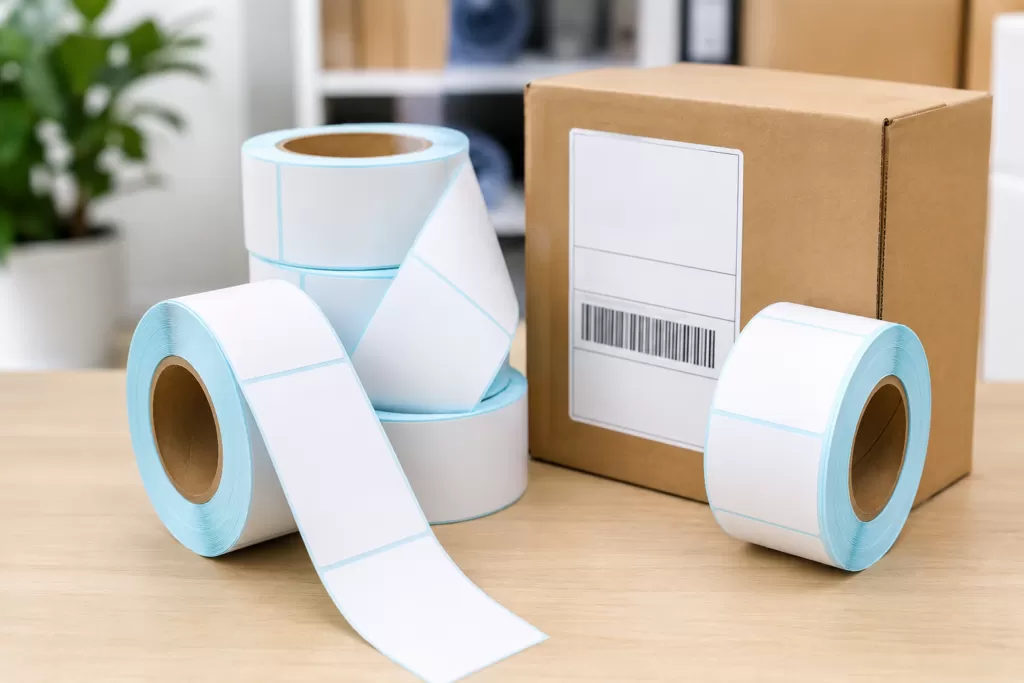
Chemical Foundations: Phenolic Chemistry vs. Non-Phenolic Label
Mechanics
To understand the transition away from bisphenol compounds, converting specialists must examine direct thermal chemistry. Traditional thermal paper relies on a three-component system suspended in a matrix: a leuco dye (such as crystal violet lactone), a coreactive organic acid developer (conventionally BPA), and a sensitizer (such as dimethyl terephthalate or diphenyl carbonate) embedded in an inert binder. Applying localized thermal energy via a print head melts the sensitizer, dissolving both the dye and the developer. The acidic developer donates a proton to the leuco dye, cleaving its lactone ring and shifting its electronic structure to absorb visible light, rendering an image.
When engineering a bpa free sticker, manufacturers historically transitioned to Bisphenol S (BPS). While chemically distinct, BPS exhibits a similar bisphenolic core that carries comparable toxicity profiles and environmental persistence. True high-integrity supply chains now bypass bisphenolic developers entirely in favor of advanced chemical alternatives:
Sulfonylurea Developers: Compounds such as Pergafast 201 function through non-phenolic urea functional groups. They act as proton donors without relying on aromatic hydroxyl groups, eliminating endocrine disruption liabilities while providing superior resistance to plasticizers, water, and lipids.
Zinc Salt-Modified Salicylic Acid Derivatives: Used predominantly in ultra-durable thermal substrates, these polyvalent metal developers deliver rapid, high-density color development with near-zero chemical volatility.
Physical Heat-Sensitive Cavitation Layers: Completely chemical-free direct thermal substrates eliminate developers and dyes entirely. Instead, they utilize a dark base layer coated with an opaque polymeric void layer that collapses under printhead heat, revealing the underlying base without chemical reactions.
Substrate Architecture and Adhesive Migration Dynamics
A pressure-sensitive label functions as an interdependent multi-layer system. The primary layers comprise the topcoat, the thermal or print-receptive layer, the base substrate (paper or filmic), the primer layer, the adhesive matrix, and the silicone release liner. When producing a bpa free sticker, engineers must account for cross-layer molecular migration.
Adhesive systems represent a primary pathway for compound migration. Low-molecular-weight species present in standard rubber or acrylic adhesives can migrate through the base substrate into the image layer, prematurely triggering thermal developers or degrading the print matrix. Water-based emulsion acrylic adhesives offer notable advantages over hot-melt options due to their tightly cross-linked polymeric chains, which restrict molecular mobility. In food contact and pharmaceutical applications, Youyi optimizes adhesive coat weights and polymer cross-linking densities to prevent trans-substrate migration, preserving label clarity across diverse storage temperatures.
Filmic alternatives to traditional paper substrates further enhance chemical barrier performance. Biaxially Oriented Polypropylene (BOPP), Polyethylene (PE), and Polyethylene Terephthalate (PET) offer dense crystal structures that act as physical shields against oil, moisture, and chemical penetration. Deploying an engineered topcoat over these films creates an impermeable surface that isolates the printing layer from external handling, preventing trans-dermal contamination during processing and distribution.
Global Regulatory Standards Governing Chemical Migration
Industrial deployment of label materials demands strict compliance with evolving international chemical registries. Manufacturers must navigate disparate regional mandates that continuously lower the thresholds for acceptable parts-per-million (ppm) of phenolic substances.
European Union: REACH and EFSA Directives
European chemical policy remains the benchmark for phenolic compound restriction. Regulation (EU) 2016/2605 amended Annex XVII to Regulation (EC) No 1907/2006 (REACH), establishing that BPA shall not be placed on the market in thermal paper in a concentration equal to or greater than 0.02% by weight (200 ppm). European Food Safety Authority (EFSA) evaluations have substantially lowered the Tolerable Daily Intake (TDI) of BPA, driving secondary packaging manufacturers to enforce zero-tolerance protocols for indirect food contact materials governed by Framework Regulation (EC) No 1935/2004.
United States: FDA and California Proposition 65
In the United States, direct food contact adhesives must comply with FDA 21 CFR 175.105, which sets criteria for migration levels through functional barriers. Simultaneously, California’s Safe Drinking Water and Toxic Enforcement Act of 1986 (Proposition 65) classifies BPA as a reproductive toxicant, enforcing strict Maximum Allowable Dose Levels (MADL) via dermal exposure. Labels utilized on consumer products sold within the state must eliminate detectable free phenols to avoid mandatory warning disclosures.
Industrial Applications Requiring Certified Clean Formulation
Various manufacturing sectors face unique technical hurdles when implementing clean, non-toxic label solutions. Material selection requires balancing substrate durability with chemical compliance.
Cold-Chain and Fresh Food Distribution
Supermarket weighing scales, carcass identification, and deep-freeze logistics represent demanding environments for any bpa free sticker. Sub-zero temperatures paired with fluctuating relative humidity lead to surface condensation. Moisture acts as a catalyst for chemical leaching if water-soluble developers are present. Utilizing emulsion-acrylic adhesives bonded to top-coated synthetic substrates ensures the label withstands moisture and oil contact without color fade or adhesive release.
Pharmaceutical and Medical Diagnostic Systems
Medical label designs cannot tolerate compound leaching into liquid active pharmaceutical ingredients stored in low-density polyethylene (LDPE) containers. Blood bags, cryo-vials, and clinical specimen tubes require adhesive formulations that avoid bisphenols, phthalate plasticizers, and aromatic solvents. In these mission-critical sectors, certified raw materials provided by Youyi deliver batch-traceable purity, mitigating the potential for chemical interaction with active medicinal compounds.
High-Speed E-Commerce Logistics and Retail Infrastructure
Industrial thermal printers operating in distribution hubs run at print speeds exceeding 12 to 14 inches per second. Non-phenolic chemical layers must exhibit rapid thermal reaction kinetics to match these throughput requirements. Slower reaction times yield blurred barcodes and lower optical read rates. Modern urea-based developers deliver the rapid kinetic response necessary to generate crisp, high-density machine-readable symbologies without causing premature printhead wear or residue buildup.
Analytical Validation and Quality Control Protocols
Verifying non-toxic label composition requires rigorous analytical protocols. Surface declarations are insufficient for cross-border industrial auditing; converters must implement advanced spectroscopic and chromatographic methodologies.
High-Performance Liquid Chromatography (HPLC) coupled with Mass Spectrometry (LC-MS/MS) serves as the primary analytical method for quantifying bisphenol concentrations down to parts-per-billion (ppb) limits. Label samples are shredded and extracted using organic solvents (typically acetonitrile or methanol) under controlled sonication. The extracted analyte is separated chromatographically through reverse-phase columns to isolate target molecules against calibrated reference standards.
Gas Chromatography-Mass Spectrometry (GC-MS) provides secondary confirmation, specifically for volatile and semi-volatile adhesive additives. For surface evaluation, Fourier Transform Infrared Spectroscopy (FTIR) with Attenuated Total Reflectance (ATR) confirms functional group properties of the protective topcoats. Through standardized testing regimens, Youyi guarantees that every lot of manufactured base material conforms to global chemical thresholds prior to slitting and distribution.
Material Specification Matrix
Evaluating raw materials requires balancing functional characteristics across common label configurations:
Standard Paper Direct Thermal: Phenol-free organic developer system; ideal for general retail, shipping, and fast-turnaround indoor applications.
Top-Coated Paper Direct Thermal: Employs water-dispersed protective barrier resins over a non-phenolic core; resistant to oils, plasticizers, and moderate abrasion.
Synthetic BOPP/PET Non-Phenolic: Ultimate environmental endurance; provides complete chemical inertia, tears resistance, and handles dynamic temperature fluctuations from -40°C to +120°C.
Thermal Transfer Formulations: Bypasses thermal reaction chemistry entirely by transferring wax, wax-resin, or pure resin ribbons onto receptor stocks; inherently free of chemical color developers.
Frequently Asked Questions
What differentiates a bpa free sticker from a phenol-free sticker?
A bpa free sticker specifically eliminates Bisphenol A, but may still incorporate chemical analogs such as Bisphenol S (BPS) or Bisphenol F (BPF) as developers. A phenol-free sticker completely eliminates all bisphenolic compounds and other aromatic hydroxyl derivatives, utilizing alternative chemistries such as urea-based compounds (e.g., Pergafast) or metal-salt developers. Phenol-free substrates provide a higher degree of future-proof compliance under international chemical frameworks.
How does removing BPA impact the lifespan of direct thermal print?
Early iterations of non-BPA developers struggled with UV light resistance and image stability. However, advanced non-phenolic developers (such as sulfonylureas) demonstrate image retention profiles that exceed classical BPA formulations. When properly shielded with a topcoat, modern clean labels maintain optical image densities exceeding 1.2 ODU for over 10 to 15 years under controlled archive conditions.
Can standard thermal printers image non-phenolic label substrates?
Yes. Non-phenolic substrates are formulated to match standard thermal energy budgets (typically between 12 and 16 mJ/mm²). Printhead voltages, burn temperatures, and strobe times do not require alteration. Technicians can interchange compliant media rolls into existing equipment profiles without reducing print speeds or sacrificing dot placement precision.
Are adhesives naturally free from bisphenolic compounds?
Most pressure-sensitive adhesives, particularly water-based acrylic emulsions and pure rubber hot-melts, are synthesized without intentional BPA additions. Trace contamination can occasionally occur if low-grade tackifiers, plasticizers, or antioxidant stabilizers contain phenolic residues. Specifying certified raw materials ensures the entire adhesive system complies with migration thresholds.
Why do shipping and warehouse environments increasingly mandate these specifications?
Warehouse, packaging, and logistics personnel handle hundreds of printed surfaces daily. Dermal transfer studies confirm that free, unbound phenolic developers applied to paper surfaces can absorb into the skin, especially when hand sanitizers containing alcohol are present. Mandating non-phenolic media across distribution networks reduces chemical exposure throughout the logistics labor force.
How do barrier topcoats prevent image fading from external plasticizers?
Standard thermal labels exposed to flexible PVC packaging or stretch wrap experience image dissolution because migrating phthalate plasticizers dissolve the dye-developer matrix. Protective barrier topcoats utilize cross-linked polyvinyl alcohol (PVA) or specialized acrylic polymers that create a dense network impermeable to large plasticizer molecules, thereby preventing direct contact with the image-forming chemicals underneath.
Procure Fully Certified, Compliant Label Substrates
Transition your production lines to verified, high-performance adhesive products engineered to meet stringent global chemical standards. Contact our technical sales and materials engineering department to request comprehensive chromatographic data sheets, compliance documentation, and sample conversion reels.
Direct Inquiries: sales@yyjnd.com | Global Sourcing & Custom Coating Division