




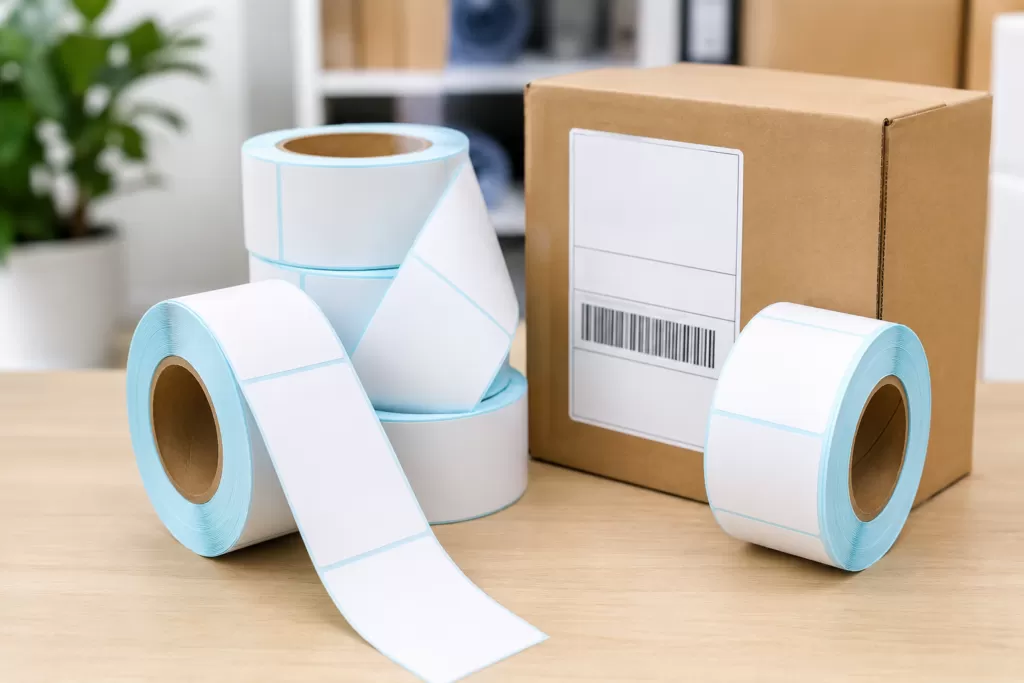
Thermal regulation in cold chain logistics, biological specimen archiving, and deep-freeze food processing creates extreme surface interfaces that rapidly degrade standard pressure-sensitive adhesives. Maintaining traceability across temperatures ranging from -20°C to -196°C requires an adhesive system engineered to withstand thermal shock, phase transition moisture, and surface energy drop-offs. Deploying a purpose-built frozen grade label ensures that critical variable data, barcode scanning vectors, and material boundaries remain intact throughout prolonged sub-zero exposure.
Industrial packaging substrates undergo dimensional contraction when exposed to rapid freezing profiles. Corrugated cartons, polyethylene pouches, and high-density polyethylene (HDPE) containers exhibit distinct thermal expansion coefficients. When standard packaging materials contract, standard adhesives crystallize, losing visco-elastic flow and peeling away under sheer mechanical stress. Resolving this engineering challenge demands precise material formulation across the facestock, primer, adhesive matrix, and release liner.
Adhesive Rheology and Glass Transition Temperature
Pressure-sensitive adhesives (PSAs) rely on viscous flow to wet out across a substrate's microscopic asperities, followed by elastic recovery to resist detachment forces. Temperature dictates the balance between these viscous and elastic properties. At the core of low-temperature adhesive performance lies the glass transition temperature, commonly designated as Tg.
Standard emulsion acrylics and conventional synthetic rubbers possess a glass transition temperature typically situated between -10°C and 0°C. When ambient operational exposure drops below this threshold, polymer chains freeze into a rigid, glassy state. Viscoelastic flow drops toward zero, eliminating the adhesive's ability to maintain molecular contact with the target surface. Once mechanical shock or substrate flexing occurs, brittle interfacial failure takes place.
Specialized adhesives engineered for low-temperature environments utilize low-Tg polymers, often engineered well below -45°C. Formulators achieve this by incorporating high concentrations of tackifying resins and soft acrylic monomers, such as 2-ethylhexyl acrylate or specialized silicone-modified elastomers. These chemistries yield specific mechanical behaviors:
Sub-Zero Viscoelastic Flow: The polymer network remains amorphous, continuing to deform plastically and wet the surface even in ambient temperatures approaching -25°C.
High Instantaneous Tack: The formulation overcomes low surface kinetic energy without requiring extended dwell time or heat activation.
Elastic Stress Absorption: The adhesive layer dynamically accommodates differing contraction rates between the container wall and the outer facestock.
In developing specialized bonding solutions, Youyi customizes adhesive coat weights and chemical backbones to balance low-temperature fluidity against elevated-temperature convertibility, mitigating adhesive edge-bleed during high-speed rotary die-cutting.
Substrate Surface Energies and Frost Displacement
Applying an identification tag directly to a pre-frozen substrate presents greater chemical resistance than applying an adhesive at room temperature prior to blast chilling. A package removed from cold storage immediately attracts atmospheric moisture, creating an interfacial layer of liquid water or crystalline frost.
Low surface energy (LSE) materials, such as untreated polyethylene or polypropylene film, already possess surface energies below 36 dynes/cm. The presence of a microscopic moisture boundary layer reduces this energy profile even further. Standard adhesives cannot displace this liquid interface, causing the label to float atop the moisture barrier rather than bonding to the container substrate.
To overcome moisture boundaries, a high-performance frozen grade label utilizes adhesive matrices designed with specific hydrophilicity-hydrophobicity balances or aggressive mechanical displacement capabilities:
Solvent Acrylic Systems: Provide high chemical cohesion and natural resistance to plasticizer migration, maintaining continuous surface wet-out despite high ambient relative humidity.
Hydrophobic Rubber-Based Formulations: Push interfacial moisture into microscopic substrate valleys, allowing tackifiers to establish polymer contact with the peaks of the substrate texture.
Targeted Coat Weight Application: Increasing dry coat weights to 24–30 g/m² provides the mechanical depth required to encapsulate frost crystals and bridge surface irregularities on blow-molded containers or rough unbleached corrugated fiberboard.
Facestock Structural Dynamics Under Thermal Contraction
The label facestock acts as the structural carrier for thermal transfer ribbons, inkjet deposits, or direct thermal chemistries. Sub-zero environments place severe physical demands on this layer, requiring strict dimensional stability and moisture barrier performance.
Cellulose-based papers present distinct limitations in extreme humidity and cyclic defrost operations. Uncoated papers absorb ambient condensation during transit stage shifts, which leads to fiber swelling, internal delamination, and subsequent barcode distortion. Saturated paper fibers quickly lose internal tensile strength, resulting in tearing upon automated package handling.
Synthetic facestocks provide superior performance for critical cold chain tracking. Selecting the appropriate polymer depends on the mechanical characteristics of the container:
Biaxially Oriented Polypropylene (BOPP): Features high tensile modulus, high transparency for clear-film applications, and dimensional stability. Ideal for rigid containers, such as glass laboratory vials and stiff polypropylene laboratory trays.
Polyethylene (PE): Highly flexible with a low tensile modulus. Polyethylene deforms alongside flexible containers, such as blood bags, vacuum-sealed meat pouches, and squeeze containers, without wrinkling or inducing shear stress into the adhesive bed.
Cast Polypropylene and Polyolefin Blends: Engineered for multi-axial conformability, these substrates prevent edge-lift on tight-radius curved surfaces, including cryotubes and ampoules subjected to liquid nitrogen immersion.
Topcoat chemistry determines print durability. High-density resin thermal transfer ribbons require specialized receptive topcoats that lock carbon pigments into the matrix, preventing smudging or mechanical abrasion caused by conveyor handling at -20°C.
Thermal Transfer and Direct Thermal Print Integrity
Preserving machine-readable data across automated distribution hubs requires precise matching between the imaging method, facestock chemistry, and cold exposure parameters. Barcode scanners rely on edge acuity and optical contrast ratios. Any degradation of the print layer halts distribution workflows.
Direct thermal papers engineered for standard retail environments incorporate basic leuco dye systems. When subjected to sub-zero refrigeration followed by room-temperature loading docks, condensation activates chemical development components, causing background discoloration and drop-offs in ANSI/ISO barcode grades. Industrial operations specify top-coated direct thermal materials that incorporate protective barrier layers against fats, moisture, oils, and alcohol-based sterilizers.
Thermal transfer printing offers the highest level of stability when using an appropriately matched ribbon and facestock. Pure wax ribbons are brittle and fracture when scraped at low temperatures. A premium frozen grade label architecture requires resin-enhanced wax or pure resin formulations. Resin cross-links chemically with synthetic facestock topcoats under printer printhead heat, creating an image layer impervious to condensation wipe-off, ice-scraping abrasion, and chemical cleaning cycles.
Converting Dynamics and Web Handling Considerations
Manufacturing a reliable low-temperature labeling solution involves complex mechanical processing. Formulating adhesives to remain aggressive at -40°C naturally increases tackiness and shear elasticity at room temperature, which can complicate converting processes.
During high-speed die-cutting and matrix stripping, soft low-Tg adhesives tend to stretch rather than fracture cleanly at the die blade edge. This adhesive stringing causes edge buildup, web breaks, and matrix re-adhesion. Solving this processing dynamic requires precise release liner selection, siliconization profiling, and tension control.
Supercalendered kraft (SCK) liners and biaxially oriented polyethylene terephthalate (PET) liners present different release profiles under converting tension. PET liners provide continuous caliper uniformity and high tensile strength, supporting high-speed automated dispensing without liner tearing. Youyi applies tight tolerances to silicone release profiles, ensuring the adhesive releases cleanly from the carrier liner at high dispensing speeds without causing label pre-dispensing inside thermal transfer printing engines.
Application Parameters Across Deep-Freeze Sectors
Operational deployment of a frozen grade label spans diverse sectors, each governed by specialized processing constraints, regulatory standards, and mechanical boundaries.
Biopharmaceutical and Cryogenic Laboratories
Biological sample containment involves harsh conditions, such as mechanical freezers (-80°C), dry ice transportation (-78.5°C), and vapor-phase liquid nitrogen storage (-196°C). Adhesives must endure rapid temperature shifts without delaminating from borosilicate glass or polypropylene cryovials. Chemical resistance to solvents such as dimethyl sulfoxide (DMSO), isopropyl alcohol, and xylene is essential, requiring high-crosslink acrylic adhesive systems paired with ultra-thin, conformable synthetic films.
Automated Food Processing and Packaging
Modern food processing facilities package poultry, seafood, and red meat under moist, chilled ambient conditions before routing products into blast-freezing tunnels operating at -40°C with high velocity airflows. Labels must adhere directly to hydrophobic polyolefin shrink films or wax-coated corrugated containers. Adhesive components must also comply with global food contact regulations, such as FDA 21 CFR 175.105 for indirect food contact, ensuring no chemical migration occurs through packaging membranes.
Cold Chain Logistics and Warehousing
Logistics facilities rely on rapid identification across variable temperature zones. Palletized loads, wrapped in low-density polyethylene (LDPE) stretch film, move from refrigerated docks into blast storage. Labels applied directly within cold warehouse aisles require application-ready performance at -15°C to avoid manual pre-warming steps. Heavy-duty logistics tags incorporate thicker adhesive layers to penetrate the micro-contours of recycled corrugated cartons.
Frequently Asked Questions
What differentiates an ambient-applied freezer label from a true deep-freeze applied label?
An ambient-applied freezer label uses an adhesive applied at standard room temperatures (typically above +5°C to +10°C). The adhesive requires standard dwell time to wet out across the substrate before temperatures drop to freezing levels. A true deep-freeze label incorporates low-Tg polymer systems capable of displacement, surface wet-out, and instantaneous bonding directly to containers that are already frozen and coated with microscopic condensation or frost layers down to -25°C.
Why do conventional packaging labels fall off substrates in cold storage?
Conventional packaging labels use acrylic or hot-melt formulations with glass transition temperatures near 0°C. Once temperatures drop into standard commercial freezers (-18°C to -25°C), the adhesive polymer chains lock into place, turning brittle and losing tack. Concurrently, the container substrate contracts. Because the frozen adhesive cannot flex with this dimensional movement, interfacial failure occurs, causing the label to detach completely.
Can thermal transfer paper labels be utilized for long-term frozen storage?
Thermal transfer paper labels can perform in frozen storage only if the packaging remains in a dry, sealed environment with zero relative humidity fluctuations. In operations where products move between varying temperature zones, condensation forms and penetrates the paper fibers. This moisture causes the facestock to swell, wrinkle, and tear. Synthetic substrates such as polypropylene (BOPP) or polyethylene (PE) are recommended for long-term reliability.
How does surface energy impact adhesive selection for plastic frozen containers?
Plastics such as high-density polyethylene (HDPE) and polypropylene (PP) are low surface energy (LSE) materials that inherently resist liquid wetting. At sub-zero temperatures, the surface energy drops even further, preventing standard adhesives from flowing into substrate pores. To secure an effective bond, the adhesive must have a lower surface tension than the plastic container, which requires aggressive tackifiers and higher coat weights.
What ribbon chemistry provides maximum durability for sub-zero barcode tracking?
Full resin thermal transfer ribbons matched with top-coated synthetic films provide maximum durability. Pure resin formulations contain specialized synthetic binders that melt precisely into the label's receptive coating, forming a cross-linked image. This print architecture resists smudging, edge distortion, moisture absorption, and physical abrasion caused by conveyor contact or handling at sub-zero temperatures.
Custom Sub-Zero Identification Solutions
Achieving stable traceability throughout sub-zero distribution demands precise alignment between facestock dynamics, adhesive rheology, and plant application limits. Standardized tape and label conversions frequently miss the specific physical parameters needed for specialized cold storage lines. Youyi develops and manufactures custom-engineered industrial tape and label structures calibrated to exact thermal profiles, mechanical run rates, and substrate textures. Submit your technical project specifications to our material engineering team to arrange specialized adhesive sampling, material compatibility evaluations, and production line trials.