




Surface finishing margins shrink quickly when masking fails. A single leak during a high-amperage plating run can ruin an entire rack of machined components or printed circuit boards. Rework adds labor, slows delivery times, and drives up operating costs. At Youyi, we manufacture surface protection materials designed to keep your plating baths clean and your rejects low.
Precision electroplating, anodizing, and etching require dependable masking materials. Standard packaging tapes break down instantly in acidic baths. This is why blue film pvc plating protective tape remains the operational benchmark across modern manufacturing plants. Choosing the right custom configuration for your production floor requires a firm grasp of your process chemistry, substrate design, and mechanical requirements.
If you are re-evaluating your masking supplies or troubleshooting recent electroplating defects, contact our technical team today to request engineered samples matched directly to your plating chemistry.
.webp?t=1793779676650 "blue film pvc plating protective tape")
1. What Is Blue Film PVC Plating Protective Tape and Why Does It Matter?
Plating tape is an engineered pressure-sensitive adhesive (PSA) tape. It uses a plasticized polyvinyl chloride (PVC) backing paired with a specialized chemical-resistant adhesive. Engineers specify PVC because it delivers a unique balance of structural flexibility, chemical inertness, and elongation.
Unlike rigid polyester or porous paper films, PVC stretches to seal around irregular contours, bolt heads, and sharp board edges. This mechanical flexibility prevents air pockets where caustic liquids collect. The backing resists sustained immersion in aggressive chemical solutions, including sulfuric acid, chromic acid, and hot alkaline pre-cleans.
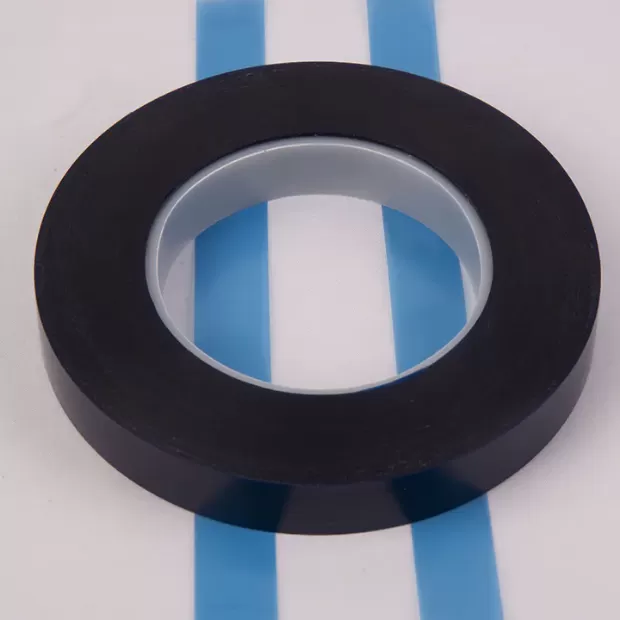
Why do manufacturing lines rely on blue film? Contrast matters on the production floor. The vivid blue tint allows machine operators and optical quality systems to verify tape positioning instantly. Operators can inspect edge lines against copper, brass, stainless steel, or green solder masks before parts enter an electroplating bath.
2. Five Critical Technical Specifications to Evaluate
No single tape specification fits every plating tank. Process engineers must evaluate five distinct technical parameters before approving a custom masking material for active production lines.
Adhesive Chemistry and Residue Control
The bond between your tape and substrate must survive aggressive agitation without breaking down. Masking tapes typically rely on two adhesive types:
- Formulated Natural Rubber: Offers high initial tack and conforms quickly to textured metal finishes. It resists acidic baths reliably and peels cleanly without shearing.
- Cross-linked Acrylic: Performs exceptionally well in high-temperature environments and alkaline baths. It resists oxidation during extended immersion runs.
Your primary goal is clean removal. Chemical bath breakdown should never compromise the adhesive matrix. Adhesives evaluated under standard methods like ASTM D3330 ensure dependable peel adhesion and guarantee clean, residue-free peel characteristics.
Backing Thickness and Elongation
PVC plating films generally range in thickness from 60 microns (2.4 mils) to 130 microns (5.1 mils). Thinner films conform tightly around complex profiles and tight radii without lifting. Thicker films provide better puncture resistance and electrical insulation during high-current-density plating cycles.
Elongation ratings typically exceed 150% to 200%. High elongation lets workers stretch the tape around irregular hardware geometry without tearing or snapping the film.
Chemical Resistance and Edge Sealing
Bath chemistry will seek any weak point along your masking edge. Strong acids can quickly attack weak adhesives, causing edge creep and bleeding underneath the tape. The blue film pvc plating protective tape you select must resist your specific chemistry:
- Copper and nickel strike baths
- Chromic and sulfuric acid anodizing
- Chemical milling and acid etching solutions
- Cyanide-based and non-cyanide gold plating baths
Thermal and Dielectric Performance
Electroplating generates substantial heat. Thermal loads increase further during post-plating bake-out cycles or heated drying tunnels. Your protective tape must hold its structural shape from 60°C up to 105°C without adhesive transfer.
Dielectric strength is equally critical. The PVC film acts as an electrical barrier, shielding masked areas from unwanted current draws. This insulating barrier concentrates electrodeposition strictly on target areas.
Calibrated Peel Adhesion
High adhesion is not always better. Excessive tack makes tape removal slow and tears thin films. Low adhesion causes bath penetration along the edges. Select an adhesion range between 2.5 N/cm and 5.0 N/cm based on your surface roughness and bath agitation rates.
3. Why Your Production Line Demands Customization
Standard master rolls rarely match real-world factory workflows. Sourcing custom tape configurations removes process friction and stabilizes output quality across shifts.
Precision die-cutting saves substantial labor. Asking assembly line workers to cut tape from a roll with a razor knife introduces edge inconsistencies, scratches components, and slows cycle times. Custom die-cut shapes match part profiles exactly. This gives workers simple peel-and-stick accuracy while ensuring repeatable edge definition.
Slitting tolerance is just as crucial. Automation-ready lines require narrow-slit rolls to feed taping machines on continuous PCB lines. Working with Youyi allows manufacturing engineers to configure exact slit widths, non-standard core sizes, and custom unwind tensions tailored for high-speed automated dispensers.
Custom formulations also solve niche chemical challenges. Aggressive processes, such as Electroless Nickel Immersion Gold (ENIG) governed by standards like IPC-4552, demand specialized adhesive formulations that will not leach organic contaminants into expensive chemical baths.
4. Core Industry Applications
High-performance protective masking protects components across several demanding industrial sectors.
Printed Circuit Board (PCB) Fabrication
PCB manufacturers use blue plating tape to protect sensitive gold finger contacts during wave soldering, tin-lead stripping, and solder mask processing. The film prevents chemical migration across copper traces without leaving adhesive traces that could ruin electrical contact resistance.
Hardware and Automotive Component Plating
Automotive trim, hydraulic rods, and aerospace fasteners require selective hard chrome and decorative nickel-chrome plating. Blue film pvc plating protective tape seals internal threads, shafts, and critical tolerance zones, eliminating expensive post-plating machining operations.
Anodizing and Chemical Milling
In aerospace manufacturing, components undergo chemical etching to reduce structural weight. Masking tape must survive strong alkaline etchants and concentrated nitric deoxidizers. PVC tape delivers sharp cut lines and peels away easily without damaging underlying bare aluminum.
5. Common Plating Defects and How the Right Tape Prevents Them
Masking errors account for a high percentage of wet-process manufacturing scrap. The right tape directly resolves these common production issues:
Defect 1: Bath Leakage and Under-Seepage
When tape lifts during plating, deposition chemistry slips beneath the backing. This leaves dark burns, unwanted plating flash, or chemical stains on target areas. Upgrading to a custom tape with high elongation and a conformable rubber adhesive seals tight against step-down surfaces, eliminating bath ingress.
Defect 2: Adhesive Residue and Substrate Staining
Standard tapes often leave gummy residue behind when exposed to heat and current. Removing this adhesive requires secondary solvent scrubbing, which risks scratching soft gold or polished finishes. A high-cohesion, cross-linked adhesive peels away cleanly in one piece, leaving bare metal untouched.
Defect 3: Edge Lifting and Flagging
Mechanical bath agitation and air sparging apply constant peel forces against tape edges. If initial tack is too low, the tape flags and catches on plating racks. Selecting an adhesive tuned for high wet-grab resistance prevents peel-back throughout vigorous agitation cycles.
6. How to Evaluate and Qualify a Custom Tape Supplier
A reliable supplier must function as an engineering partner, not just a commodity broker. Screen your tape converters against these core capabilities:
- In-House Formulation and Coating: Can the supplier adjust adhesive tack, backing plasticizers, or release characteristics to match your bath chemistry?
- Quality and Environmental Certifications: Look for ISO 9001 quality systems alongside verified RoHS and REACH compliance to confirm that films are free of banned phthalates and heavy metals.
- Rapid Prototyping Capabilities: Your vendor should provide fast-turn custom slit rolls or sample die-cuts so your engineering team can run pilot bath trials before placing bulk purchase orders.
- Lot-to-Lot Consistency: Variations in film thickness or adhesive cross-linking will disrupt automated processing lines. Demand comprehensive Certificates of Analysis (COA) with your production orders.
Frequently Asked Questions (FAQ)
Q1: What makes blue PVC tape better than polyester (PET) tape for
electroplating?
A1: Polyester tape provides excellent heat
resistance, but it lacks elongation. It cannot stretch around three-dimensional
hardware or step-down edges. Blue film pvc plating protective
tape stretches easily around irregular geometry, forming a leak-proof
mechanical seal that rigid PET films cannot match.
Q2: Will the adhesive leach chemicals and contaminate our plating
baths?
A2: Premium plating tapes use cross-linked adhesive matrices
formulated specifically for wet chemical immersion. They will not dissolve,
break down, or leach organic silicones or heavy metals into delicate plating
solutions when applied within rated temperatures.
Q3: What surface preparation is required before applying PVC masking
tape?
A3: Substrates must be dry and free of cutting oils, rolling
lubricants, and residual polish. Clean surfaces thoroughly with isopropyl
alcohol or run parts through a mild alkaline wash. Any residual surface oils
will lower tape tack and increase the risk of bath seepage.
Q4: Can this tape withstand high-temperature bake cycles after
plating?
A4: Most PVC plating tapes tolerate continuous operating
temperatures between 60°C and 85°C, with intermittent resistance up to 105°C. If
your process requires high-temperature post-baking above 130°C, consult our
technical team to discuss specialized polyimide or high-temp polyester
options.
Q5: Can I order custom die-cut shapes for small production
runs?
A5: Yes. Modern converting facilities supply custom die-cut
shapes on release liners for both prototype runs and high-volume manufacturing.
Custom pre-cut parts improve placement speed and eliminate the surface damage
caused by hand-trimming with utility knives.
Optimize Your Masking Line with Engineered Solutions
Surface masking tape should protect your production yield, not put it at risk. Choosing the right blue film pvc plating protective tape prevents chemical seepage, speeds up post-plating cleanup, and protects your bottom line against scrap costs.
Youyi develops custom surface protection tapes for demanding finishing facilities worldwide. Our engineering team can calibrate adhesive tack, roll dimensions, and die-cut shapes to match your exact plating chemistry.
Stop dealing with plating leakage and tape residue. Contact our sales engineering group today with your process specifications, operating temperatures, and bath chemistries to request a custom quote and free sample evaluation kit.