



Thermal processing changes everything in industrial coating. When temperatures inside a curing oven climb past 150°C, standard commercial tapes fail catastrophically. Adhesives liquefy, backings curl, and paint bleeds underneath masking lines. Worst of all, baked-on adhesive residues turn post-processing into a costly labor bottleneck.
Selecting the right high-temperature paint masking tape prevents these processing failures. Precision manufacturers across the automotive, aerospace, and electronics sectors rely on engineered masking solutions to preserve critical tolerances. Youyi manufactures high-performance tapes built specifically to endure extreme heat cycles while peeling away cleanly.
This technical guide explores how high-temperature paint masking tape performs under intense thermal loads. We examine backing substrates, adhesive chemistry, industrial use cases, and best practices to help you optimize production efficiency.
What Is High-Temperature Paint Masking Tape?
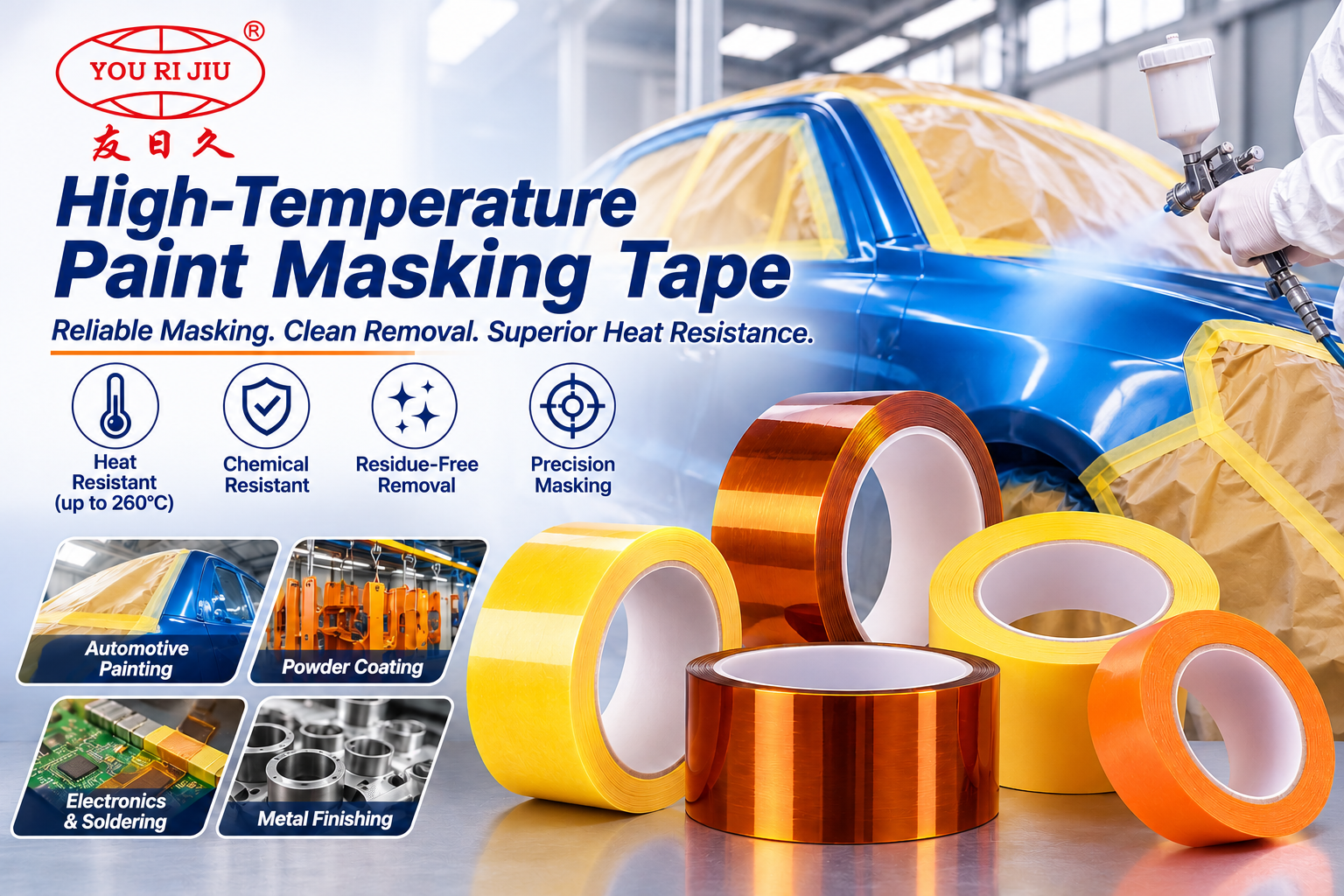
High-temperature paint masking tape is a purpose-built adhesive product designed to shield specific surfaces during high-heat coating, baking, and curing cycles. Unlike conventional utility tapes, these industrial materials endure extreme baking profiles without degrading, shrinking, or transferring adhesive to the substrate.
The tape relies on a synergistic relationship between a heat-stabilized carrier and a crosslinked adhesive layer. International testing bodies like ASTM International specify rigorous evaluation methods, such as ASTM D3330 for peel adhesion, to ensure industrial tapes withstand these demanding production variables.
During electro-deposition, powder coating, or liquid spray processes, Youyi masking tapes resist thermal breakdown. They block aggressive paint solvents while establishing crisp edge definition along complex geometries.
Core Backing Materials: Engineering for Thermal Endurance
A tape's thermal and mechanical threshold depends largely on its backing substrate. Youyi supplies multiple carrier materials to match precise operational temperatures and mechanical loads.
1. Saturated Crepe Paper
Crepe paper backings undergo impregnation with heat-resistant polymers to prevent brittleness during bake cycles. This carrier flexes easily along curved body panels and irregular contours.
- Typical Operating Range: 120°C to 160°C (up to 320°F).
- Core Strengths: Excellent conformability, easy hand-tearing, and cost-effective performance.
- Primary Uses: Automotive paint booths, industrial machinery refinishing, and low-bake oven cycles.
2. Polyester Film (PET)
Polyester films offer superior tensile strength, cut-through resistance, and dimensional stability. PET carriers maintain razor-sharp masking lines because their thin cross-section prevents heavy coating buildup along the edge.
- Typical Operating Range: 160°C to 204°C (up to 400°F).
- Core Strengths: High dielectric strength, excellent tear resistance, and supreme chemical inertness.
- Primary Uses: Electrostatic powder coating, e-coating baths, and anodizing lines.
3. Polyimide (PI) Film
Polyimide film represents the pinnacle of thermal carrier performance. It delivers exceptional mechanical integrity and flame resistance at temperatures that melt standard synthetic polymers.
- Typical Operating Range: 200°C to 260°C continuous (short peaks up to 300°C).
- Core Strengths: Extreme heat resilience, zero shrinkage, and broad solvent resistance.
- Primary Uses: Wave soldering, circuit board masking, aerospace composite curing, and high-temp powder coats.
Adhesive Systems: Silicone vs. Modified Rubber
The backing carrier handles the heat, but the adhesive chemistry governs bonding, wet-out, and residue-free release. High-temperature paint masking tape typically utilizes one of two advanced adhesive systems.
Rubber-based adhesives offer high initial tack. Chemists modify these formulations with vulcanizing agents and heat stabilizers to raise their natural thermal ceiling. They bond aggressively to metals, plastics, and primed composites. While budget-friendly for operations under 160°C, rubber formulations degrade faster if exposed to prolonged heat cycles.
Silicone adhesives represent the benchmark for intense heat resistance. Built upon an inorganic silicon-oxygen backbone, silicone polymers withstand oxidation, UV degradation, and sustained thermal stress up to 260°C. Silicone wet-out properties allow effortless repositioning before oven entry. Crucially, silicone releases cleanly from smooth substrates without leaving tacky residues behind.
Key Industrial Applications
Precision manufacturing operations depend on specialized masking tapes to protect sensitive zones from powder, paint, chemical vapors, and thermal oxidation.
Automotive Manufacturing and Refinishing
Modern automotive assembly lines subject vehicles to multi-stage drying ovens. Youyi high-temperature paint masking tape seals door jambs, engine bays, and two-tone paint margins. Technicians pull the tape after baking to reveal sharp, burr-free color separations that elevate finished vehicle aesthetics.
Industrial Powder Coating
Powder coating requires electrostatic application followed by oven curing between 180°C and 200°C. The powder liquifies, flows, and polymerizes under heat. High-temperature paint masking tape shields threaded studs, tapped holes, ground points, and bearing surfaces from coating contamination, eliminating secondary tapping or cleaning.
Aerospace and Defense Finishing
Aerospace components require compliance with strict specifications, such as quality frameworks governed by the International Organization for Standardization (ISO). Operators use polyester and polyimide tapes to isolate titanium, magnesium, and carbon-fiber assemblies during aggressive paint and resin curing protocols.
Electronics and Printed Circuit Board Assembly
During wave soldering and reflow processes, molten solder contacts bare PCB surfaces. Polyimide high-temperature masking tape shields edge connectors, gold fingers, and delicate microchips from thermal shock and molten solder bridges.
Metal Plating and Anodizing
Chemical baths strip unprotected metals quickly. Youyi supplies chemical-resistant masking tapes that withstand acidic anodizing tanks, electroplating currents, and heavy rinsing cycles without flagging or peeling.
Key Features of Youyi High-Temperature Masking Solutions
Engineers design Youyi masking solutions to eliminate production downtime. Each roll incorporates advanced material technologies that keep manufacturing lines moving.
- Engineered Thermal Stability: Maintains structural cohesion across varied industrial thermal cycles without edge-lift.
- Residue-Free Clean Peel: Peels off cleanly in one continuous piece, removing the need for scraping, sanding, or chemical solvents.
- Edge-Seal Anti-Bleed Barrier: Micro-engineered edges block thin-solvent automotive lacquers and fluid powder coats.
- Broad Solvent and Acid Resistance: Resists aggressive paints, clearing agents, chemical washes, and e-coat solutions.
- Flexible Conformability: Hugs steep curves, weld seams, and stamped profiles without tearing or bubbling.
Selection Guide: Choosing the Right Masking Tape
Choosing the wrong high-temperature paint masking tape causes expensive rework. Production managers should evaluate four primary operational parameters before choosing a tape specification:
1. Peak Temperature and Dwell Time
Evaluate your process heat profiles thoroughly. A tape rated for 200°C during a 10-minute flash cycle may fail if baked for 45 minutes. Match both maximum temperature and dwell duration to the technical data sheet.
2. Substrate Surface Energy
Low-surface-energy (LSE) materials like certain plastics and powder-primed components require higher-tack adhesive systems. High-surface-energy metals (aluminum, stainless steel) wet out easily but bond aggressively under heat, demanding stable release chemistry.
3. Coating Chemistry
Determine the vehicle system: Is it a waterborne basecoat, aggressive solvent enamel, or dry thermoset powder? Solvent-heavy sprays demand impervious PET carriers, while conformable crepe paper suits high-solid automotive paints.
4. Demasking Profile: Hot vs. Cold Peel
Does your assembly line strip masking immediately out of the oven, or do components cool down first? Polyimide and PET silicone systems handle hot peels cleanly. Modified rubber paper tapes often perform best when peeled warm or completely cooled.
Best Practices for Clean Application and Removal
Even premium tape underperforms if applied improperly. Follow these standardized procedures to achieve clean masking lines and flawless surfaces.
First, clean the target substrate thoroughly. Remove oil, grease, cutting fluid, and moisture using isopropyl alcohol or specialized degreasers. Allow surfaces to dry completely before applying high-temperature paint masking tape.
Second, apply uniform pressure along the tape backing using a smooth squeegee or roller. Pressure activates the adhesive polymers, pushing out trapped air and seating the edge firmly against surface irregularities.
Third, peel the tape at the correct angle. Pull the tape smoothly back over itself at a 90-degree to 135-degree angle. Steady, moderate pulling speed ensures the cleanest edge release while preventing adhesive shear transfer.
Frequently Asked Questions (FAQ)
Q1: What happens if I use standard masking tape in a powder coating oven?
A1: Standard masking tape adhesives quickly oxidize, melt, and cross-link irreversibly under high temperatures. The paper backing chars and tears into fragments upon removal. Worse, the adhesive fuses into the substrate, requiring mechanical scraping or harsh solvents that ruin the base finish.
Q2: Can Youyi high-temperature paint masking tape withstand multiple bake cycles?
A2: Yes, depending on the chosen product grade. Polyester and polyimide tapes featuring crosslinked silicone adhesives readily survive multi-pass oven cures. Always verify your total cumulative thermal dwell time against our product specifications.
Q3: How do I eliminate adhesive residue after baking?
A3: Match the adhesive chemistry to your substrate and thermal profile. Avoid over-baking beyond rated temperature limits, apply the tape to clean surfaces, and peel the tape at a consistent 90-degree to 135-degree angle. If residue occurs, inspect your oven for localized hot spots that exceed the tape's thermal limits.
Q4: Why does powder coat sometimes bleed past the masking edge?
A4: Paint bleed usually stems from inadequate application pressure, uneven substrate textures, or air entrapment along the seam. When the powder melts into a liquid film inside the oven, capillary action draws it into micro-gaps. Applying firm roller pressure eliminates these voids.
Q5: Can I use high-temperature paint masking tape on sensitive plastics?
A5: Yes, but testing is essential. Many engineering plastics outgas volatile compounds when heated, which can soften the tape's adhesive. Select a tape formulated with balanced peel adhesion to prevent surface crazing or bonding failure during the thermal cycle.
Why Leading Manufacturers Choose Youyi
Youyi has developed industrial adhesive technologies for decades. We engineer our tapes under strict quality systems to guarantee batch-to-batch consistency. Our automated coating lines ensure uniform adhesive distribution, exceptional tensile durability, and reliable release characteristics.
Whether you manage an automotive assembly facility, an electrostatic powder coating plant, or a PCB manufacturing line, Youyi delivers tailored masking solutions. We offer precision custom slitting, varied roll lengths, and specialized die-cut shapes to streamline your production line.
Elevate your finishing quality and protect your production margins. Contact the Youyi engineering team today to review process specifications, request product samples, and discover the ideal high-temperature paint masking tape for your operations.