




A single unreadable barcode can stop a freight shipment in its tracks. Warehouses run on automated sorting systems that read barcodes in milliseconds. When a logistics label tears, smudges, or peels off a corrugated box, automated sorters reject the carton. Workers must divert the package, manually look up order records, and reprint the label.
These delays introduce compounding costs into distribution networks. Carriers issue penalty chargebacks for non-compliant barcodes. Customer delivery windows close, resulting in missed service-level agreements. At Youyi, we manufacture packaging adhesive solutions that keep freight moving smoothly through complex fulfillment lines. If your warehouse battles label degradation, submit an inquiry to our technical team today for custom adhesive tape samples and bulk pricing.
Securing your logistics label requires understanding the environmental and mechanical stresses packages face during transit. This guide outlines why labels fail, how custom packaging tape provides a rugged shield, and how to optimize your carton-sealing operations.
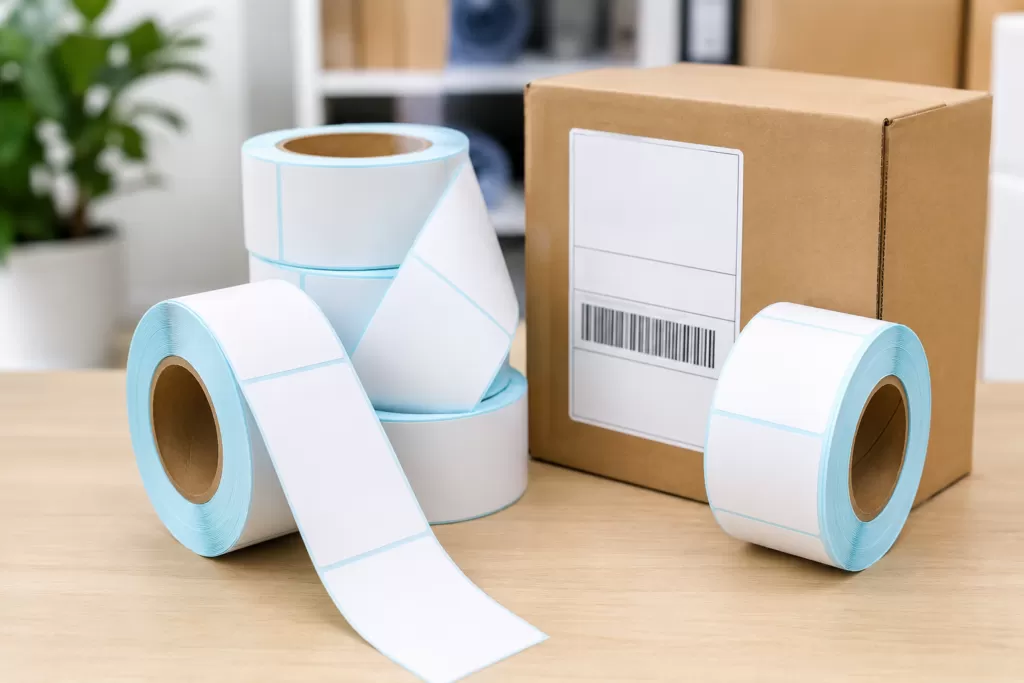
Why Logistics Label Integrity Dictates Supply Chain Success
Modern distribution hubs rely on fixed-position optical scanners, high-speed line cameras, and handheld RFID/barcode readers. These systems read code standards such as GS1-128, Code 39, and 2D Data Matrix symbols. High scanning throughput demands high visual contrast between printed bars and label substrates.
When a logistics label sustains minor surface friction, the print layer degrades. Direct thermal labels turn black when exposed to radiant heat or friction. Thermal transfer ribbons can flake off untreated paper faces under rough handling. The result is instant scanning failure.
Consider the core vulnerabilities that threaten a logistics label throughout cross-docking and shipping:
Surface Abrasion: Vibration against truck walls and rubbing on belt conveyors grind away thermal print layers.
Moisture Infiltration: High humidity, rain on loading docks, and condensation weaken paper label fibers, leading to tears.
Chemical Exposure: Airborne greases, machine oils, and cleaning solvents dissolve printer inks and weaken standard label glues.
Adhesion Failure: Low-temperature storage environments make standard label adhesives brittle, causing edges to lift and curl.
When an automated system cannot decode a logistics label, packages drop into manual exception lanes. Manual intervention takes time, adds labor costs, and increases the chance of misrouted cargo.
Common Modes of Logistics Label Failure
Protecting labels requires pinpointing where they break down during freight handling. Industrial transit exposes outer packaging to harsh physical forces.
Mechanical Abrasion and Conveyor Scuffing
Fulfillment centers use miles of powered roller and gravity-drop conveyors. Packages drop down metal chutes and collide on accumulation tables. As boxes shift against one another, friction acts like sandpaper across the face of an exposed logistics label.
Paper-based labels have low shear resistance. Unprotected paper quickly frays at the edges. Once an edge lifts, mechanized sortation tines or transfer plates rip the label away from the corrugated carton completely.
Environmental and Temperature Shock
Trailers and shipping containers experience massive temperature swings. A container parked in the sun can reach interior temperatures above 50°C (122°F), while winter airfreight drops below freezing. Direct thermal labels react to heat by darkening across their entire surface, which eliminates contrast and makes barcodes completely unreadable.
Sub-zero conditions cause different problems. Cold temperatures cause standard pressure-sensitive glues to freeze, lose tack, and detach from recycled corrugated boards.
Optical Glare and Surface Distortion
Some packaging teams cover labels with low-grade utility tape to stop physical damage. However, poor-quality films introduce high surface gloss and uneven optical refraction. When an automated laser scanner hits a reflective tape surface, the beam bounces back, blinding the optical reader.
Wrinkles formed during manual tape application distort the geometric proportions of linear barcodes and QR matrices. The scanner reads the distortion as an invalid code format.
Custom Packaging Tape: Engineered Protection for Critical Labels
Corrugated cardboard containers need reliable closure, but packaging tape can also protect your shipping labels. Custom packaging tape combines strong film backings with targeted adhesive formulas to seal cartons and guard tracking documents simultaneously.
Clear Biaxially Oriented Polypropylene (BOPP) tape works as an industrial shield over shipping documents. High-grade BOPP films resist tears, handle moisture, and absorb impact shocks that would destroy bare paper labels.
Applying wide custom packaging tape directly over a printed logistics label creates an effective, low-cost barrier. It protects print surfaces from outside weather and prevents cartons from bursting open during transit.
Material Selection: Choosing the Right Film and Adhesive
Not all packaging tapes suit label protection and box sealing equally. Material chemistry directly affects long-term adhesion, clarity, and barcode readability.
Backing Film Substrates
BOPP (Biaxially Oriented Polypropylene): The global standard for packaging security. BOPP film stretches in both directions during manufacturing, giving it exceptional dimensional stability, high tensile strength, and optical clarity that allows instant barcode scanning.
PET (Polyester): Offers superior puncture resistance and withstands higher temperatures, making it ideal for hazardous materials and heavy ocean cargo.
Reinforced Kraft Paper: Water-activated paper tape creates an unmistakable, tamper-evident bond with corrugated boxes, though clear windows are required if placed over a printed logistics label.
Adhesive Formulations
The adhesive layer must bond firmly to diverse substrates, including virgin kraft board, high-recycled fluting, and synthetic paper labels.
Water-Based Acrylic: Delivers outstanding UV stability and optical clarity. Acrylic adhesives will not yellow over time, ensuring your logistics label remains scannable through extended warehouse storage.
Hot-Melt Synthetic Rubber: Provides quick initial tack and strong shear adhesion. Hot-melt tape creates an aggressive instant bond on corrugated cartons, making it perfect for fast-paced automated packing lines.
Solvent-Based Adhesives: Built for extreme conditions. Solvent acrylics hold up under freezing cold, intense heat, and high humidity, keeping labels protected in harsh outdoor environments.
As a specialized manufacturer, Youyi produces high-grade BOPP films and balances adhesive formulations to meet challenging industrial demands. If your distribution process handles extreme cold storage or heavy handling, request a custom adhesive evaluation from Youyi to optimize tape performance across your network.
Best Practices for Applying Tape Over Shipping Documents
High-grade packaging tape requires proper application techniques to prevent label failures. Packing stations must follow clean, standardized processes to avoid sorting issues downstream.
1. Position Labels Away from Box Edges and Seams
Never place a logistics label directly over the center seam, corner folds, or structural score lines of a box. When cartons flex under top loads, seams compress and stretch, which wrinkles the label and cracks the barcode print.
Place the label flat on the largest box face, leaving at least 50 mm (2 inches) of space between the label edge and any carton score line.
2. Prevent Air Pockets and Wrinkles
Air bubbles trapped under protective tape create optical barriers. Hand-held tape dispensers should have flexible wipe-down blades to smooth out the tape as it touches the box.
Operators must apply even pressure, starting from the center of the label and working outward. This step pushes out air pockets and forms a tight, waterproof seal across the entire surface.
3. Manage Tape Gloss to Prevent Scanner Glare
High-speed sortation centers use high-intensity LED and laser arrays. Inexpensive, highly reflective tapes create bright specular reflections that blind optical sensors.
Choose protective packaging tape with low-glare coatings or high optical clarity. The light must pass cleanly through the film to read the barcode bars and spaces without refraction errors.
Economic Advantages: Custom Protective Tape vs. Document Enclosed Pouches
Many distribution operations use plastic "Packing List Enclosed" pouches to protect outbound shipping paperwork. While these pouches work, they introduce extra material costs and slow down packing speeds.
Workers must peel release liners, drop documents into thin plastic sleeves, stick the pouch down, and seal the closure flap. This multi-step process wastes precious seconds on fast-moving fulfillment lines.
Using wide clear or custom-printed packaging tape to seal the box and protect the logistics label cuts material costs significantly. BOPP tape costs up to 60% less per application than standard self-adhesive clear pouches. It also removes the waste of siliconized paper liners from packing stations, supporting your facility's waste-reduction goals.
Brand Value and Anti-Tampering Security
Custom packaging tape can do more than protect package labels. It transforms ordinary brown boxes into secure, branded assets. Printing your company logo, handling instructions, or tracking alerts directly onto the tape elevates your brand image across the delivery journey.
Custom printed tape also acts as an effective tamper-evident seal. Pilferers in transit hubs often cut ordinary clear tape, steal products, and reseal boxes with standard transparent tape. A box sealed with custom-branded tape cannot be opened and resealed without leaving obvious physical evidence.
Combining brand identification with label protection simplifies inventory intake. Receiving teams instantly spot genuine cartons, verify brand origins, and scan the protected logistics label without removing protective layers.
Frequently Asked Questions
Q1: Can barcode scanners read a logistics label through clear
packaging tape?
A1: Yes, as long as you use high-clarity BOPP tape
applied smoothly without air bubbles or heavy wrinkles. Low-grade utility tapes
can create glare or optical distortion that interferes with laser and
vision-based scanners. We recommend using acrylic-based clear tape designed for
optical transparency.
Q2: Will covering a direct thermal label with packaging tape turn the
label black?
A2: Standard direct thermal paper reacts to heat,
pressure, and certain solvents. Some lower-grade packaging tapes contain
plasticizers or aggressive solvent adhesives that can turn direct thermal paper
dark over time. To avoid this, use top-coated direct thermal labels alongside
water-based acrylic packaging tape.
Q3: What tape width is best for covering and protecting a logistics
label?
A3: Standard shipping labels measure 4x6 inches (100x150 mm).
A 3-inch (72 mm) tape roll requires two overlapping passes to cover the label.
Using a 4-inch (96 mm) or 6-inch (144 mm) wide roll allows operators to cover
and secure the entire label in a single, efficient pass.
Q4: How does packaging tape perform in cold chain and refrigerated
transport?
A4: Standard packaging tapes lose adhesion and peel off
corrugated boxes in cold conditions. Facilities handling refrigerated or frozen
products should use cold-temperature solvent adhesives or specialized acrylic
formulations. These adhesives maintain flexible bonding strength down to -20°C
(-4°F).
Q5: Can custom packaging tape replace external packing list envelopes
entirely?
A5: Yes. Many modern warehouses print combined packing
slip and logistics label documents on single adhesive-backed sheets. Applying a
single layer of clear protective tape over this document secures the package,
protects the address data, and eliminates the need for separate plastic
envelopes.
Partner with Youyi for Industrial Packaging Solutions
A damaged logistics label costs more than the paper it is printed on. It causes shipping delays, triggers carrier chargebacks, and harms relationships with end customers. Protecting your cartons and barcodes requires durable, dependable materials engineered for real-world shipping conditions.
Fujian Youyi Adhesive Tape Group operates world-class production facilities, running advanced coating lines and precision slitting machinery. We supply bulk BOPP film tapes, custom printed packing tapes, and specialized adhesive solutions to corporate logistics teams around the globe. Our materials are engineered to maintain high tensile strength, withstand heavy abrasion, and provide clean optical clarity for every logistics label in your network.
Cut shipping exceptions and secure your cartons today. Contact our international sales department to request technical specifications, schedule factory audits, or order customized production samples. Let our adhesive experts configure the right packaging protection for your global supply chain operations.